




Earlier this summer, popular British author and etiquette expert William Hanson visited Bergen County as part of a promotional tour for his new book, Just Good Manners, and this reporter was in attendance for his presentation. Hanson combines history especially of the Victorian era with dry wit and straightforward advice for evolving old rules of behavior to keep in step with modern societal change and navigating social interactions in 2025.
William Hanson may be the modern day Emily Post, an American author who first wrote Etiquette in Society, in Business, in Politics, and at Home in 1922, a manual of basic manners and social rules. Post unified and popularized a practical approach to social behavior with her best seller and follow up newspaper columns and radio appearances. Like Post, Hanson views etiquette in a practical sense, not so much as a rigid set of rules to be followed, but instead as a toolkit that smooths out social interactions. The reason he is popular with teenagers is that his newspaper column equivalent is the use of social media, such as his popular accounts on Instagram and TikTok.
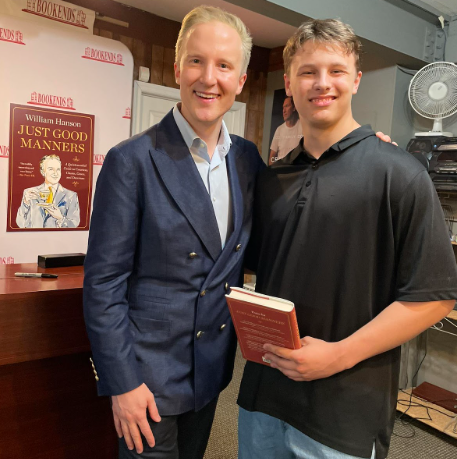
His advice covers everything from table manners and airplane behavior to how to line up in a queue, without notably the poor manners of ‘saving a spot’ for someone else. While these might be simple concepts, the ability to set expectations by which we can get along as a civilized society makes things easier. Driving for example, in an expected and courteous way, both avoids car accidents and makes driving time more efficient for everyone. He infuses unique British peculiarities and culture and compares it to American habits. Someone at the book signing made the mistake of asking about the British royal family, testing Hanson’s policy of ‘answering all questions’, and he dutifully provided an analysis of what’s going on with Harry and Meghan.
This reporter took the opportunity to ask a dining etiquette question during Hanson’s talk, specifically how to handle eating something complicated and messy like spaghetti at a business lunch. His advice, in one word, “don’t”. He said even if you see another diner enjoying the best plate of pasta you’ve ever seen at another table, it is not worth introducing something that complicated to a business lunch where the purpose is business. Instead he says, make plans to come back the next day with friends, and enjoy your spaghetti then.